Relay Protection Test Sets — Three-Phase and Six-Phase
The VAE-430 and VAE-660 inject AC and DC current and voltage into protection relays for commissioning, routine maintenance and scheme validation. Six independent current channels, parallel output to 180 A, and a built-in controller so the set works without a laptop.
- AC accuracy ≤ 0.2 %
- 6 × 30 A, 1 × 180 A paralleled
- Six voltage channels, ±360° phase
- Stand-alone operation
Why these two, and not a bigger box
Most protection work needs three currents and three voltages. Some needs six, synchronised. Buying channels you never energise costs money and adds weight to every site visit — so the family is split in two, sharing the same accuracy class and operating model.
Six independent current channels
The VAE-660 drives six currents simultaneously with 1 mA resolution, so both ends of a differential scheme are energised at once instead of in two passes.
Paralleled high current
Channels combine when a test needs bulk current: 1 × 120 A on the VAE-430, 3 × 60 A or 1 × 180 A at up to 1000 VA on the VAE-660.
Runs without a PC
Both sets carry a built-in controller with LCD and local keypad. Standard tests run stand-alone; serial and USB interfaces are there when you want PC-driven automation.
AC and DC from one unit
Current and voltage sources cover AC and DC ranges, so DC auxiliary and DC injection tests do not need a second instrument on site.
Choose the channel count
Same accuracy class, same stand-alone philosophy. The difference is how many currents you can energise at once, and what that buys you in scheme coverage.
| VAE-430 | VAE-660 | |
|---|---|---|
| Current output | 3 × 0–40 A AC | 6 × 0–30 A AC |
| Paralleled current | 1 × 0–120 A | 3 × 0–60 A · 1 × 0–180 A |
| Current power | 3 × 420 VA at 40 A | 6 × 300 VA at 30 A · 1000 VA at 180 A |
| Voltage output | 4 × 0–120 V AC · 1 × 0–240 V | 6 × 0–120 V AC · 3 × 0–240 V |
| Accuracy | AC ≤ 0.2 % · DC ≤ 0.5 % | AC ≤ 0.2 % · DC ≤ 0.5 % |
| Phase control | — | ±360° |
| Binary I/O | 8 inputs / 4 outputs | USB and serial for PC automation |
| Weight | 22 kg | 20.3 kg |
| Typical fit | Overcurrent, distance, frequency, three-phase differential | Transformer, generator and busbar differential; schemes needing six currents |
Where they are used
- Substation commissioning
- Routine protection maintenance
- Transformer and generator differential
- Busbar and line differential
- Distance and auto-reclosing schemes
- High-burden electromechanical relays
- Metering CT verification
- Protection training and coursework
See the test screens, not just the box
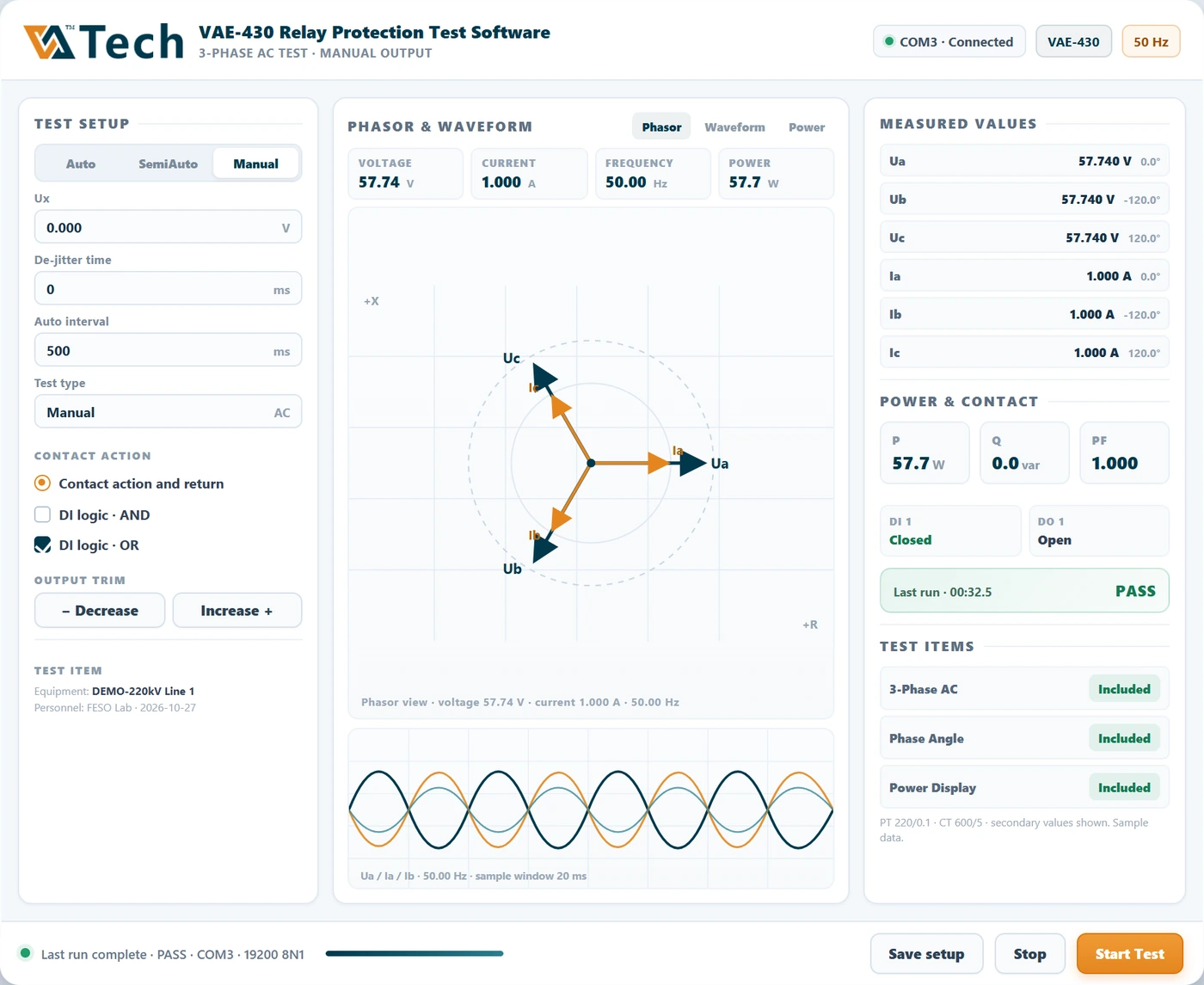
The VAE-430 software is being redesigned around the test workflow: a launcher for the modules, a three-phase AC screen with phasor and waveform, and a distance / zero-sequence screen with the R-X plane and records in one view.
Questions buyers ask before ordering
Three-phase or six-phase — which one do I actually need?
Can it test IEC 61850 process-bus relays?
Does it need a laptop on site?
How much current can be delivered on one phase?
What about high-burden electromechanical relays?
Tell us the relays you test
Send the relay models and the schemes you need to cover — overcurrent, distance, transformer differential, busbar — and we will confirm which set fits, what it costs, and what the lead time is.
Prefer email? sales@fesotest.com
Phone / WhatsApp: +86 132 6572 6720