
 VA-TEK Team
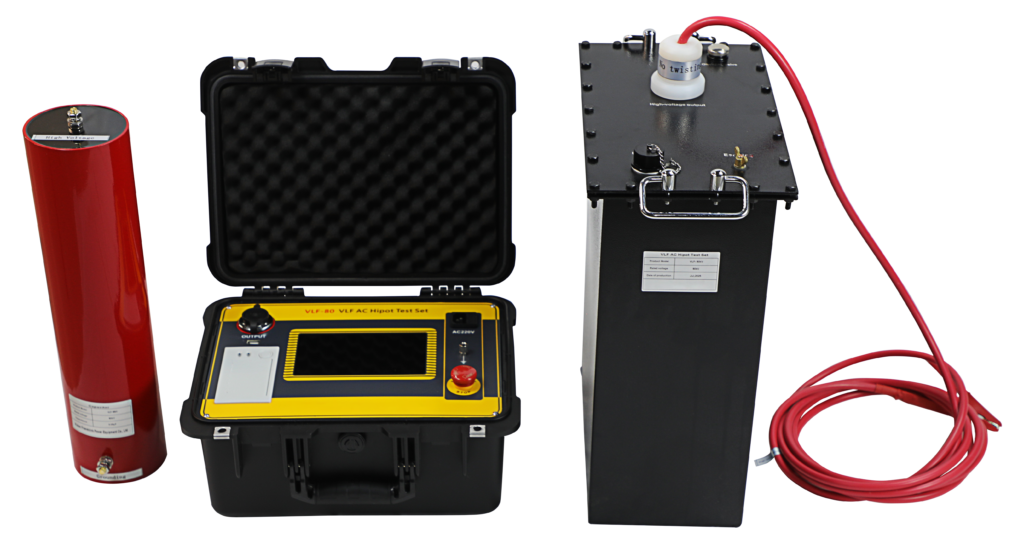
Choosing a vlf test set comes down to three questions, and they hurt in a fixed order. Get the voltage wrong and the instrument cannot test the cable at all. Get the load wrong and it stalls part-way up a long feeder. Get the third wrong and the test passes, but the record is thinner than the network asked for.
The VLF hipot family answers all three: one split-platform withstand line covering 30 kV to 90 kV peak in six ratings, and two diagnostics for 5–15 kV and 5–25 kV cable. Every unit runs the same four output frequencies — 0.1 Hz, 0.05 Hz, 0.02 Hz and 0.01 Hz.
Voltage: what the cable class demands
The first question belongs to the cable, not the instrument. The controlling figure is U0, the rated phase-to-earth voltage. Acceptance of new cable, joints and terminations sits at about 3U0; maintenance of aged cable at about 2U0. Our VLF versus DC article works through that derivation; the certified figure comes from the standard’s tables.
An 8.7/15 kV cable needs about 26 kV at acceptance and a 20.3/35 kV cable about 61 kV, both inside the 90 kV peak of the VLF-30-90 withstand line. Every rating here is peak, never multiplied by the square root of two.
Load and reach: how far one set goes
The second question sets the machine’s size. A VLF set drives a capacitor, so its charging current is proportional to capacitance and frequency: at a fixed voltage, the current a cable draws falls in step with the test frequency. Dropping from 0.1 Hz to 0.01 Hz cuts that demand tenfold, which is what lets one tank hold full voltage on a much longer run.
What decides the reach is therefore the set’s output current at the frequency you choose, not the peak voltage on its own — a higher peak rating raises the ceiling voltage but does not by itself drive more capacitance. Match the capacitance of the longest scheduled circuit against the set’s published load rating at your chosen frequency before you commit, and step down the frequency when a run is long.
Beyond a withstand: diagnostics and sheath testing
The third question is what the job has to produce besides a pass or fail. A withstand says the cable held, not how much margin is left.
Two models carry the extra front end. The VLF-34TD and the VLF-45TD add tan-delta diagnostics over a 5 nF to 10 µF load range at 1.0 × 10⁻⁴ accuracy, plus DC testing and sheath testing with sheath fault location: a 10 kV sheath test at 0.1 to 5.0 mA. The withstand line carries neither, so a scope calling for tan delta should not be written around one of those units. Weight follows the same split: a 4 kg controller plus a 20 to 55 kg tank on the withstand line; a single 22 kg or 23 kg case on the two diagnostics.
This article stays on selection. For the underlying method — how the standard’s Table 3 sets the acceptance voltage, why 0.1 Hz, and when to add tan delta or partial discharge — see the complete VLF cable testing guide.
Frequently asked questions
Can one vlf test set cover every cable class?
A set covers any shielded cable whose specified test voltage falls inside its rating; the largest units here reach 90 kV peak. Capacitance is the second limit, so a long circuit can exceed a set’s reach even when the voltage fits.
Does a higher peak voltage mean more reach?
Not on its own. Reach is set by the set’s output current and the test frequency: a higher peak rating lifts the ceiling voltage but does not by itself charge more capacitance. For a long run, step down the frequency.
Two-piece or single unit?
The split sets put a 4 kg controller in one hand and the tank in the other, which suits manholes. The diagnostics are single cases.
Where the family stops
The largest units in the family are 90 kV peak, which puts 66 kV acceptance out of reach: a 38.1/66 kV cable has a U0 of about 38 kV and an acceptance level near 114 kV. The maintenance level for that class, about 76 kV, is reachable, and so is every class below it.
To match a vlf test set to a cable class, route length and diagnostic scope, send VA-TEK the cable schedule.
Sources
- IEEE 400.2-2024, Field Testing of Shielded Power Cable Systems Using Very Low Frequency (VLF): acceptance and maintenance levels derived from U0.
- IEC 60502-2, power cables with extruded insulation from 1 kV to 30 kV: in-situ AC testing.
- VA-TEK product data, VLF family (vendor data): output voltages and unit weights; output current 0–30 mA on the withstand line, 0–14 mA on the VLF-34TD and VLF-45TD; tan delta accuracy 1.0 × 10⁻⁴ over 5 nF to 10 µF; sheath test 10 kV at 0.1–5.0 mA.
- U0 of the cable classes quoted (8.7/15 kV, 20.3/35 kV, 38.1/66 kV); levels about 3U0 and about 2U0, rounded to the nearest kV (vendor data).
