
 VA-TEK Engineering
Transformer differential vector group compensation testing proves that the 87T relay’s internal Y-Δ or Δ-Y compensation and balance coefficients produce near-zero differential current for a balanced load, and correct operation for an internal fault. It verifies the phase shift, CT ratio matching, and zero-sequence elimination.
Key takeaways
- The transformer shifts the phase. A Y/Δ-11 transformer shifts the LV side by 30 degrees. The relay must compensate for that shift before it compares the currents.
- CT ratios must match. The balance coefficients correct the amplitude difference between the HV and LV CTs. A wrong ratio produces a differential current on a healthy load.
- Zero-sequence must be trapped. A Y-side earth fault or an unbalanced load can produce zero-sequence current that the delta winding does not pass. The relay must eliminate it from the differential calculation.
- Use six currents. A full three-phase, two-side test needs six independent currents; the VAE-660 is the correct test set for this job.
- Prove both states. Balanced load must produce near-zero differential current; an internal fault must trip.
What does a vector group compensation test prove?
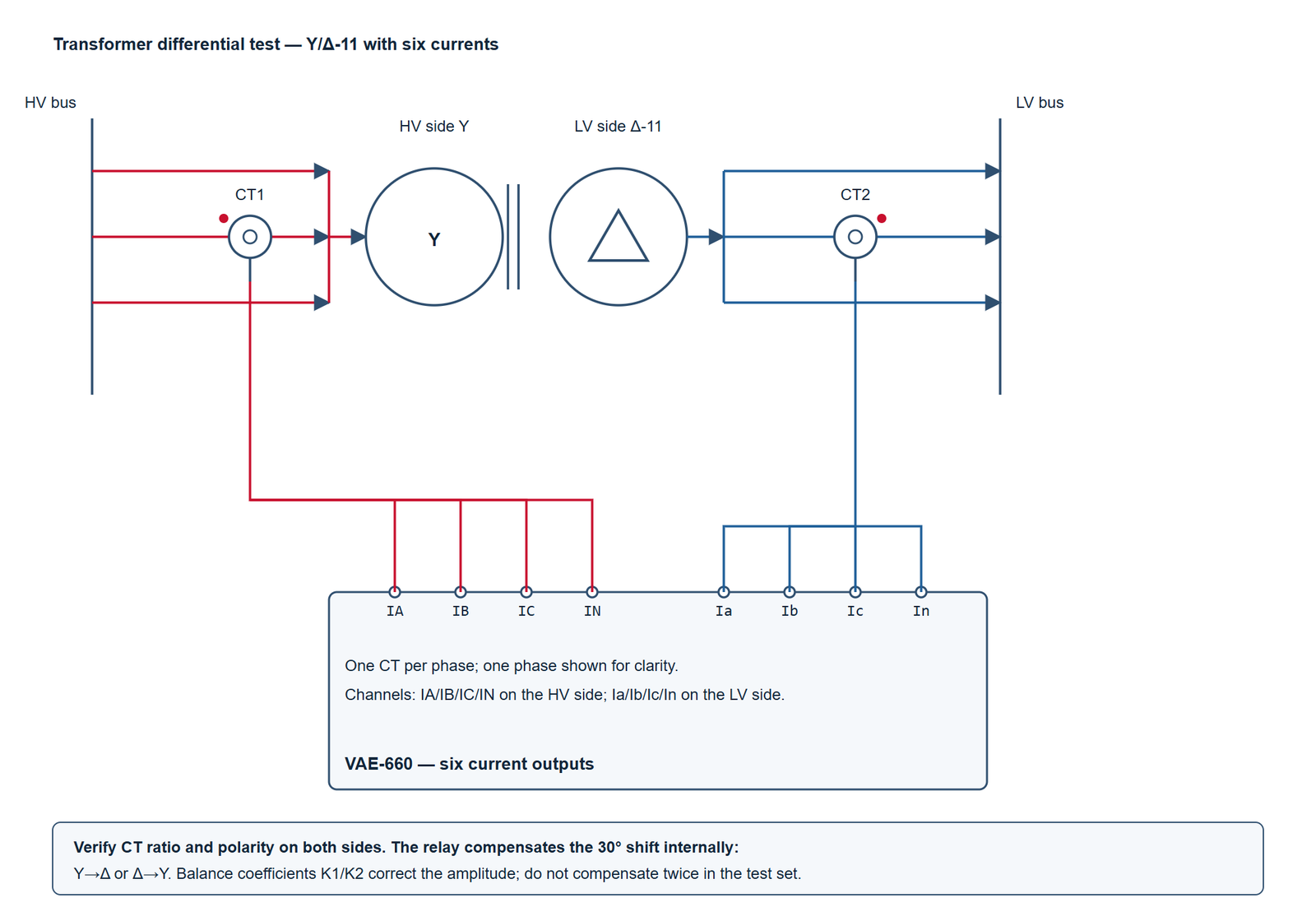
A transformer differential relay compares the currents on the HV and LV sides after compensating for the transformer’s vector group and the CT ratios. For a Y/Δ-11 transformer, the LV side lags the HV side by 30 degrees. The relay applies a phase shift, usually Y→Δ or Δ→Y, and a set of balance coefficients to make the two sides comparable.
The test proves that the compensation matrix is correct, the CT ratio and balance coefficients are correct, the zero-sequence current is eliminated, and the relay trips for an internal fault while remaining stable for a balanced load and an external fault.
How do you test vector group compensation?
- Record the transformer data. Note the vector group, the HV and LV rated voltages, the CT ratios, and the relay’s compensation settings.
- Calculate the expected secondary currents. For a balanced load, calculate the current on each side after the CT ratio. The relay’s balance coefficients should make the two sides equal.
- Connect six currents. Use the VAE-660: IA, IB, IC and IN to the HV-side current inputs; Ia, Ib, Ic and In to the LV-side current inputs. Observe the polarity on both sides.
- Apply a balanced load. Inject the calculated currents with the correct phase shift. Confirm that the relay’s differential current is near zero.
- Check the phase shift. If the differential current is not zero, reverse the phase sequence on one side or change the compensation setting, one at a time, and observe the effect.
- Apply an internal fault. Increase the current on one side only and confirm that the relay trips according to the differential characteristic.
- Apply an external fault. Increase both sides together and confirm that the relay remains stable.
- Check zero-sequence elimination. Inject a zero-sequence current on the Y side and confirm that it does not appear as a differential current.
What settings and test points should you use?
| Setting | Example value | Test point | Expected result |
|---|---|---|---|
| Vector group | Y/Δ-11 | Balanced load | Id near zero |
| HV CT ratio | 200/1 | 1.0 In secondary | Correct metering |
| LV CT ratio | 1000/1 | 1.0 In secondary | Correct metering |
| Balance coefficient K1 | 1.00 | Balanced load | Id below 0.05 Ie |
| Balance coefficient K2 | 1.00 | Balanced load | Id below 0.05 Ie |
| Differential pickup | 0.3 Ie | 0.25 Ie / 0.35 Ie | No trip / trip |
| Slope | 0.3 | 2 x pickup | Stable |
How do you wire the VAE-660 to the relay?
| VAE-660 terminal | Relay terminal | Note |
|---|---|---|
IA, IB, IC, IN |
HV-side current inputs | First current set; observe polarity |
Ia, Ib, Ic, In |
LV-side current inputs | Second current set; observe polarity |
DI A |
Trip contact | Dry contact from the relay |
COM+KM |
Trip contact common | Common for the digital inputs |
The VAE-430 can test one side at a time, but it cannot inject six currents simultaneously. Use the VAE-660 for the full vector group compensation test; use the VAE-430 for a single-side function check or for the relay’s test-mode injection.
What is the pass criterion?
- Balanced load: differential current below 0.05 Ie, or the relay manual’s stability limit.
- Phase shift: the measured differential current is minimum at the correct vector group setting.
- Internal fault: trip at the set pickup and slope.
- External fault: no trip for a through-fault within the stability limit.
- Zero sequence: no differential current for a zero-sequence injection on the Y side.
- Repeatability: three balanced-load measurements within 0.01 Ie.
Why is the differential current not zero on a balanced load?
Wrong vector group. A 30-degree error or a phase-sequence swap produces a large differential current that does not disappear when the current is reduced. Check the relay’s vector group setting against the transformer nameplate.
Wrong CT ratio or balance coefficient. The differential current is proportional to the load current. Recalculate the secondary currents and compare them with the relay metering on each side.
Zero-sequence current. A Y-side zero-sequence current that is not eliminated appears as a differential current. Check the zero-sequence elimination setting and the CT connection.
Polarity. A reversed CT on one side produces a differential current that is twice the load current. Check the polarity dot on every CT.
Frequently asked questions
Why does a Y/Δ-11 transformer need 30-degree compensation?
The delta winding shifts the phase between the HV and LV sides by 30 degrees. Without compensation, the relay would compare currents that are not in phase and would see a differential current even on a healthy load.
Can I test vector group compensation with the VAE-430?
The VAE-430 has three currents and four voltages, so it can inject one side at a time. A full three-phase, two-side compensation test needs six currents; use the VAE-660.
What is a balance coefficient?
A balance coefficient scales one side of the differential calculation to match the other side after the CT ratios. It compensates for the difference between the HV and LV CT secondary currents at rated load.
Why does the relay trip on an external fault?
The CTs may saturate at different times, the ratio or balance coefficient may be wrong, or the relay may not have enough bias. Check the CT excitation curves and the relay’s bias characteristic before changing the settings.
How do I test zero-sequence elimination?
Inject a zero-sequence current on the Y side only and confirm that the relay’s differential current remains near zero. Repeat with a phase-to-earth fault if the relay has a dedicated zero-sequence element.
Where VA-TEK test sets fit
The VAE-660 provides six currents and six voltages for a full three-phase, two-side vector group compensation test. The VAE-430 is suitable for single-side checks and for relays with a test-mode injection. Start with the relay protection testing hub and the relay testing whitepaper.
Related reading: transformer differential protection testing for the bias and harmonic tests, and when to use six-phase relay testing for the channel-count decision.
Standards and references
- IEEE C37.91-2021 — guide for protective relay applications to power transformers.
- IEEE C57.13-2016 — standard requirements for instrument transformers.
- IEC 60076-1:2011 — power transformers, general requirements (vector groups).
- Relay manufacturer’s technical manual — compensation matrix and balance coefficients.
VAE-430 · relay protection test set
See the software before you buy the set
Every VAE-430 runs the same 20-module PC software. Watch it drive a three-phase AC test and a distance fault, then ask us for the test package.
- US$2,000per set, EXW
- 9interface languages
- 7 daysdelivery
- Includedfull test software
Field-commissioning workflows, IEC and IEEE time curves, COMTRADE playback and a full DI/DO matrix — on one PC, with no per-module licence.
Request the software test package
Tell us which relay family you test. We reply with pricing, lead time and the matching setup files within one business day.
