
 VA-TEK Engineering
Power swing blocking testing proves that the 68 element detects a slow impedance movement and blocks the distance protection before it reaches a zone, then unblocks when the swing is stable or trips when it is unstable. It verifies the characteristic, the timers, and the unblock logic.
Key takeaways
- A swing is slow; a fault is a step. The 68 element distinguishes the two by the rate of impedance change, not by the impedance value alone.
- Two characteristics, one timer. The inner and outer blinders define the detection zone; the timer defines how long the element waits before it blocks.
- Blocking is temporary. A stable swing should unblock after the swing passes; an unstable swing should trip or transfer to the out-of-step element.
- Do not test the distance zones at the same time. Isolate the 68 logic first, then test the distance zones separately.
- Record the locus. A single test point does not prove the swing detection; record the impedance trajectory and the time.
What does a power swing blocking test prove?
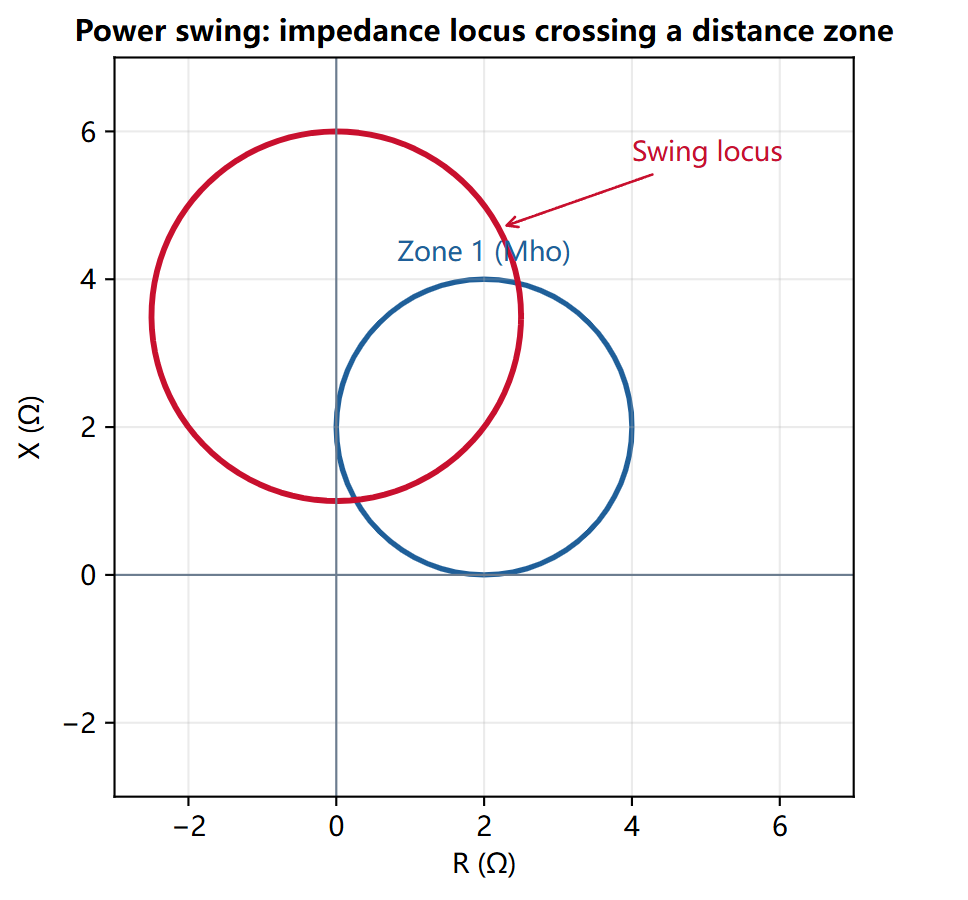
A power swing is a slow oscillation of the rotor angles after a disturbance. The impedance seen by a distance relay moves through the R-X plane, and it can enter a distance zone without a fault. The 68 element detects the slow movement and blocks the distance trip, so the relay does not trip on a stable swing.
The test proves that the element detects the swing at the set rate, blocks within the set time, holds the block while the swing is present, and unblocks or trips when the swing is classified. It also proves that a true fault still trips through the blocking logic.
How do you test a power swing blocking element?
- Record the settings. Note the inner and outer blinder positions, the swing detection timer, the unblock timer, and the distance zones that are supervised.
- Connect three currents and three voltages. Use IA, IB, IC and UA, UB, UC with UN. Confirm the relay measures the expected impedance.
- Start at a load point. Set the pre-fault current and voltage so that the impedance is outside the distance zones and outside the blinders.
- Move the impedance slowly. Ramp the current and voltage so that the impedance crosses the outer blinder, then the inner blinder, then the zone. Record the time and the trajectory.
- Confirm the block. The distance element should pick up but the trip should be blocked while the 68 element is active.
- Repeat with a fast step. Apply a step change that represents a fault and confirm that the distance trip is not blocked.
- Test the unblock. Let the swing return to a stable point and confirm that the block resets. Then apply an unstable swing and confirm the trip or the transfer to the out-of-step element.
- Check the timers. Measure the block assertion time and the unblock time against the settings.
What settings and test points should you use?
| Setting | Example value | Test point | Expected result |
|---|---|---|---|
| Zone 1 reach | 2.0 ohm | 1.8 ohm | Zone 1 pickup |
| Inner blinder | 0.7 x zone | Slow crossing | Detect |
| Outer blinder | 1.2 x zone | Slow crossing | Detect |
| Swing timer | 0.05 s | Slow ramp | Block after 0.05 s |
| Unblock timer | 0.10 s | Stable swing | Unblock after 0.10 s |
| Fault step | Step to 0.5 x zone | Instantaneous | Trip, not blocked |
| Unstable swing | Locus passes the zone | Out-of-step | Trip or transfer |
How do you wire the VAE-430 to the relay?
| VAE-430 terminal | Relay terminal | Note |
|---|---|---|
IA, IB, IC |
Phase current inputs | Three-phase current source |
IN |
Current neutral | Common return |
UA, UB, UC |
Phase voltage inputs | Three-phase voltage source |
UN |
Voltage neutral | Common return |
DI A |
Trip contact | Dry contact from the relay |
DI B |
Block or alarm contact | Optional; use if the relay provides a status output |
COM+KM |
Contact common | Common for the digital inputs |
What is the pass criterion?
- Detection: the 68 element asserts for a slow crossing at the set rate.
- Block: the distance trip is blocked within the set time.
- No block for a fault: a step change trips without the blocking delay.
- Unblock: the block resets when the swing is stable.
- Unstable swing: the trip or the out-of-step transfer occurs as configured.
- Timers: within 10 ms of the settings.
Why does the relay trip during a swing, or fail to block?
The swing is too fast. If the impedance moves faster than the detection rate, the element may not block in time. Check the ramp rate and the setting; the rate must be below the detection threshold.
The impedance did not cross both blinders. The element may require a crossing of the outer and inner characteristics in sequence. A single-point test does not prove the detection.
The distance zone is not supervised. Confirm that the 68 element is mapped to the zone that is picking up. A block on Zone 2 does not block Zone 1 if the logic is separate.
The unblock timer is too short. The relay may unblock while the swing is still present and then trip on the next zone entry. Check the unblock logic and the swing period.
Frequently asked questions
What is the difference between 68 and 78?
The 68 element blocks the distance protection during a power swing. The 78 element detects an unstable swing and trips the breaker at a controlled angle. They are complementary functions, and some relays combine them.
Why block the distance protection during a swing?
A stable swing can move the impedance into a distance zone without a fault. Tripping on a stable swing can separate the system and make the disturbance worse. The block gives the system time to recover.
How do I simulate a power swing with a test set?
Use a sequence of current and voltage steps so that the impedance moves along the desired locus. If the test set software supports a smooth ramp, use a slow ramp; record the trajectory and the time, not only the end point.
Can I test the 68 element with a single current and voltage?
Only if the relay uses a single-phase impedance element. For a three-phase distance relay, use three currents and three voltages and confirm the phase selection.
What happens if the swing is unstable?
The 78 element or the 68 unblock logic should trip or transfer to the out-of-step function. The correct behavior depends on the scheme; confirm it against the setting file, not against a generic rule.
Where VA-TEK test sets fit
The VAE-430 provides three currents and four voltages, enough for a three-phase power swing test with a fourth voltage for polarizing or sync check. Start with the relay protection testing hub and the relay testing whitepaper.
Related reading: distance protection relay testing for the zone tests. The out-of-step function (78) is covered in a separate procedure.
Standards and references
- IEEE C37.113-2015 — guide for protective relay applications to transmission lines.
- IEEE C37.90-2005 — surge withstand capability of relay systems.
- IEC 60255-121:2014 — functional requirements for distance protection.
- Relay manufacturer’s technical manual — power swing detection logic and timers.
VAE-430 · relay protection test set
See the software before you buy the set
Every VAE-430 runs the same 20-module PC software. Watch it drive a three-phase AC test and a distance fault, then ask us for the test package.
- US$2,000per set, EXW
- 9interface languages
- 7 daysdelivery
- Includedfull test software
Field-commissioning workflows, IEC and IEEE time curves, COMTRADE playback and a full DI/DO matrix — on one PC, with no per-module licence.
Request the software test package
Tell us which relay family you test. We reply with pricing, lead time and the matching setup files within one business day.
